
Latest Articles
ML-Based Security Analytics in NetFlow Analyzer: Detecting Advanced Network Threats Through Behavioral Analysis
This article explores how machine learning (ML) and network flow telemetry can be used to establish behavioral baselines, detect anomalous asset activity, and map suspicious network behavior to the MITRE ATT&CK framework. We'll also walk through a realistic security investigation showing how reconnaissance, unusual internal communication, and low-and-slow data exfiltration can be identified through changes in an endpoint's normal traffic behavior.
Modern cyberattacks don't always trigger immediate firewall or IDS/IPS alerts. Once an attacker compromises a legitimate endpoint, reconnaissance, lateral movement, and data exfiltration can occur quietly through network traffic that may appear legitimate when examined in isolation.
This raises an important question for network and security teams:
How do you identify potentially malicious activity when the individual network connections don't immediately look malicious?
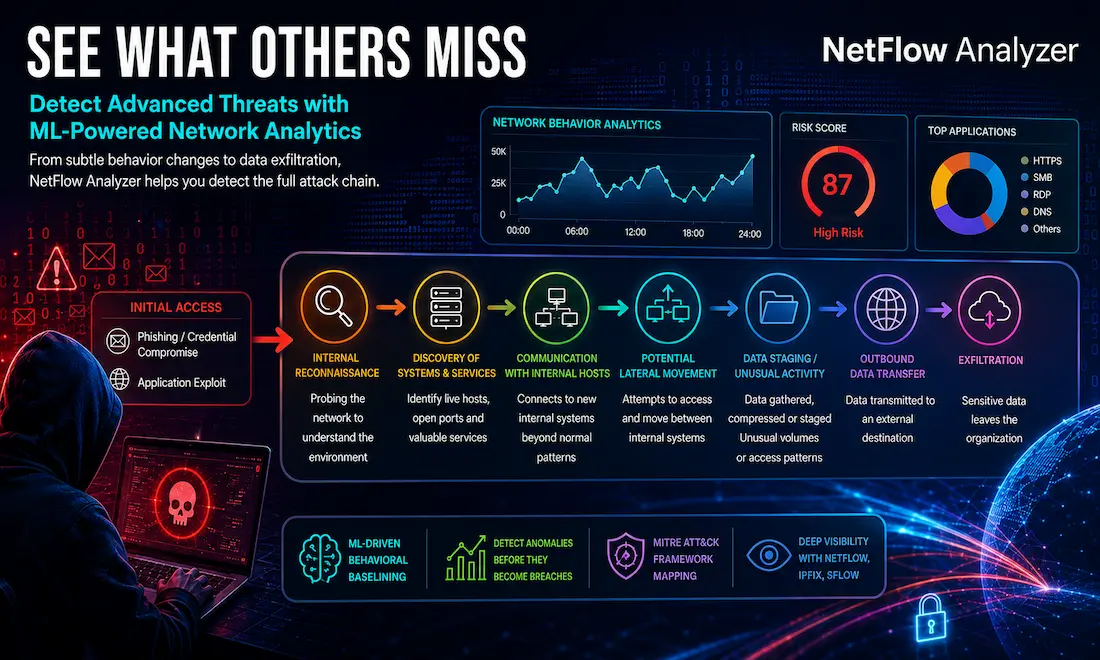
A modern NetFlow Analyzer can help answer this by examining NetFlow, IPFIX, sFlow, and other flow telemetry already generated by network infrastructure. When combined with ML-driven behavioral baselining, anomaly detection, risk scoring, and MITRE ATT&CK-aligned detections, this telemetry can reveal deviations from an asset's normal network behavior that traditional signature- or threshold-based monitoring might overlook.
Key Topics Covered
- Why Advanced Threats Can Be Difficult to See
- From NetFlow Telemetry to Security Analytics
- Understanding ML-Driven Behavioral Baselining
- Moving From Anomaly to Attack Context With MITRE ATT&CK
- How Security Analytics Complements Traditional Network Defenses
- Practical Investigation: Detecting a Silent Data Exfiltration Attack
- Why Flow Analytics Is Particularly Valuable for Security Teams
- Summary
Related Articles:
- Complete Guide to Netflow: How Netflow & its Components Work. Netflow Monitoring Tools
- Netflow: Monitor Bandwidth & Network Utilization. Detect LAN, WAN, Wi-Fi Bottlenecks, Unusual Traffic Patterns, Problems and more
- NetFlow Analyzer: Free Download, Step-by-Step Installation, Configuration & Optimization Windows - Linux
- Netflow vs SNMP. Two Different Approaches to Network Monitoring
Why Advanced Threats Can Be Difficult to See
Consider a relatively common attack sequence. An attacker may gain an initial foothold inside the network through several methods, including:
1. Phishing / Credential Compromise
From Alerts to Action: How Agentic AI will change your ITOps
As modern IT environments continue to grow in size and complexity, the challenge is no longer detecting issues—it's resolving them quickly before they impact the business. ManageEngine's Agentic AI for OpManager Nexus is designed to bridge the gap between intelligent monitoring and intelligent action. This practical guide explores how AI-powered agents can transform IT operations by automating investigation, accelerating root cause analysis (RCA), and assisting engineers in resolving incidents faster and with greater confidence.
The white paper introduces the five levels of ITOps autonomy, helping organisations understand their current operational maturity and build a realistic roadmap toward autonomous operations. It also highlights practical use cases where agentic AI is already delivering value, including AI-assisted RCA and intelligent war rooms that reduce response times and improve collaboration during critical incidents.
 Topics Covered
- The five levels of ITOps autonomy and how to assess your organisation's AI maturity.
- Real-world Agentic AI use cases, including AI-assisted root cause analysis and intelligent war rooms.
- Five key controls for safe AI adoption, covering governance, reversibility, and continuous learning.
- An 18-month crawl-walk-run implementation roadmap for introducing and scaling Agentic AI.
- A four-lever ROI framework to measure reductions in downtime, manual effort, recurring incidents, and capacity waste.
- How OpManager Nexus enables Agentic AI using live topology, the MCP Server, and Zia Agents.
- Best practices for transitioning from traditional monitoring to autonomous, AI-driven IT operations.
Whether you're just beginning to explore AI-driven operations or looking to advance your automation strategy, this white paper offers practical guidance, proven frameworks, and a clear roadmap for adopting agentic AI with confidence.
Endpoint Security Under Pressure: How to Stay Ahead of Modern Cyber Threats
 Cyberattacks no longer happen on a predictable schedule. Ransomware can cripple systems within minutes, while zero-day vulnerabilities are often exploited before patches even exist. With remote work, BYOD policies, cloud applications, and growing endpoint fleets now the norm, IT and security teams are under constant pressure to stay ahead of evolving threats.
The challenge is not a lack of effort. It is having the right visibility, insights, and tools to respond quickly and effectively.
The Endpoint Security for Dummies guide is designed for endpoint administrators, security engineers, IT managers, and CISOs looking for practical ways to strengthen endpoint security without adding unnecessary complexity.
Inside the guide, you’ll learn how modern attackers identify weaknesses and target endpoint environments, how to proactively detect vulnerabilities, and how to build layered protection across devices, identities, networks, and sensitive data.
The guide also explores how AI-driven detection and response can help security teams identify threats faster, automate investigations, and improve incident response capabilities before incidents escalate.
You’ll also gain access to:
- Practical security checklists for CISOs and IT administrators
- Strategies for defending against advanced threats such as fileless malware and ransomware-as-a-service (RaaS)
- Best practices for building a security-first culture across the organisation
- Actionable frameworks to strengthen endpoint resilience and reduce risk exposure
 Whether you are starting your endpoint security journey or refining an existing strategy, the right knowledge can make a measurable difference. This guide provides practical, actionable insights that security teams can apply immediately.
Detecting Insider Threats and Shadow IT Through Firewall Log Analysis
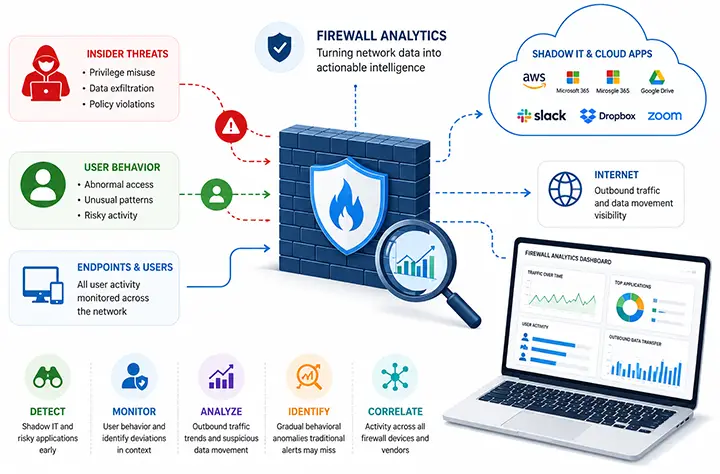
 This article explores the key indicators of insider threats and shadow IT hidden within firewall logs, the behavioral patterns security teams should monitor, and how advanced firewall analytics can help IT and security teams detect abnormal activity, improve application visibility, and identify emerging security risks before they impact business operations.
Key topics:
- Why insider threats and shadow IT are hard to detect
- Key indicators of insider threats and shadow IT in firewall traffic and session data
- How SaaS adoption and unmanaged applications expand the enterprise attack surface
- Best practices for identifying abnormal user, application, and outbound traffic behavior
- How firewall log analysis helps uncover hidden security and compliance risks
- Using ManageEngine Firewall Analyzer to improve visibility, detect anomalies, and strengthen network security monitoring
- Summary
Related Articles:
- 7 Essential Firewall Management Strategies for Maximum Security
- Achieving Modern Compliance: Navigate PCI DSS v4.0 with Firewall Analyzer
- Challenges & Solutions to Managing Firewall Rules in Complex Network Environments
- Dealing with Security Audit Challenges: Discovering vulnerabilities, unauthorized access, optimize network security & reporting
- Discover the Ultimate Firewall Management Tool: 7 Essential Features for Unleashing Unrivaled Network Security!
- Ensuring Compliance and Business Continuity in a Hybrid Work Environment
- Master Your Firewall: 6 Expert-Backed Steps to Boost Security, Performance, and Compliance
Firewall Analyzer simplifies firewall auditing, helps identify vulnerabilities and compliance risks before they impact your network.
Why Insider Threats and Shadow IT Are Hard to Detect
Insider threats and shadow IT present a significant detection challenge because they rarely resemble conventional malicious activity. In most cases, there is no obvious exploit attempt, malware signature, or unauthorized access event to trigger immediate concern. Instead, the activity originates from authenticated users, trusted devices, approved applications, and legitimate communication channels already permitted within the organization’s security policies. From the perspective of traditional firewalls and perimeter-based controls, the traffic often appears fully compliant with expected operational behavior.
Enterprise-Class Cloud & Network Monitoring

Threat Traffic Analysis

Wi-Fi Key Generator
IT Infrastructure Monitoring

Follow Firewall.cx
Recommended Downloads
Cisco Password Crack
Decrypt Cisco Type-7 Passwords on the fly!
Automated Patching Solution

Firewall Analyzer

Featured Categories:





Top Picks:
Boost Network Security and Efficiency with Intell…

Challenges & Solutions to Managing Firewall Rules…
Introduction to Palo Alto Next-Generation Network…
Free Webinar - Dealing with Remote VPN Challenges…

VTP Pruning
VLAN Tagging - Understanding VLANs Ethernet Frames

Static VLANs

Dynamic VLANs
The IP Routing Process - Step-by-Step Analysis
OSPF - Part 3: OSPF Adjacency & Neighbor Forming Process. OSPF Hello Messages, OSPF Database Updates via Link State Requests (LSR & LSU)
OSPF - Part 1: Introduction, OSPF Packet Structure, OSPF Messages and Characteristics