The Application layer of the OSI model is where users communicate with the computer. The Application layer is responsible for identifying and establishing the availability of the intended communication partner and determining if sufficient resources for the intended communication exist. The user interfaces with the computer at the application layer.
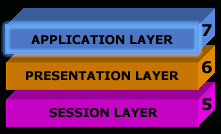 Although computer applications sometimes require only desktop resources, applications may unite communicating components from more than one network application, for example, file transfers, e-mail, remote access, network management activities, client/server processes.
There are various protocols which are used at this layer. Definition of a"Protocol" is a set of rules by which two computers communicate. In plain English, you can say that a protocol is a language, for example, English. For me to speak to you and make sense, I need to structure my sentence in a "standard" way which you will understand. Computer communication works pretty much the same way. This is why we have so many different protocols, each one for a specific task.
The last 3 layers of the OSI model are reffered to the "Upper" layers. These layers are responsible for applications communicating between hosts. None of the upper layers know anything about networking or network addresses.
Free eBook - Endpoint Security

Enterprise-Class Cloud & Network Monitoring

Bandwidth Monitor

Wi-Fi Key Generator
Network and Server Monitoring

Follow Firewall.cx
Recommended Downloads
Cisco Password Crack
Decrypt Cisco Type-7 Passwords on the fly!
Automated Patching Solution

Firewall Analyzer