The Session layer is responsible for setting up, managing and then tearing down sessions between Presentation layer entities. The Session layer also provides dialog control between devices, or nodes. It coordinates communication between systems and serves to organise their communication by offering three different modes: simplex, half-duplex and full-duplex. The session layer basically keeps one application's data separate from other application's data.
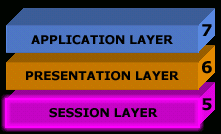
The last 3 layers of the OSI model are reffered to the "Upper" layers. These layers are responsible for applications communicating between hosts. None of the upper layers know anything about networking or network addresses.
Some common protocols which work at the Session layer are: DNS, LDAP, NetBIOS.
Some examples of Session-layer protocols are:
Network File Systrem (NFS) : Was developed by Sun Microsystems and used with TCP/IP and Unix workstations to allow transparent access to remote resources.
Structured Query Language (SQL): Was developed by IBM to provide users with a simpler way to define their information requirements on both local and remote systems.
Remote Procedure Call (RPC): Is a broad client/server redirection tool used for disparate service environments. Its procedures are created on clients and performed on servers.
X Window: Is widely used by intelligent terminals for communicating with remote Unix computers, allowing them to operate as though they were locally attached monitors.
Free eBook - Endpoint Security

Enterprise-Class Cloud & Network Monitoring

Bandwidth Monitor

Wi-Fi Key Generator
Network and Server Monitoring

Follow Firewall.cx
Recommended Downloads
Cisco Password Crack
Decrypt Cisco Type-7 Passwords on the fly!
Automated Patching Solution

Firewall Analyzer