ISDN (Integrated Services Digital Network) is a digital telephone standard designed to replace analogue connections by utilising ordinary copper wires that are used in standard analogue telephone systems. It started as a recommendation within the ITU's (International Telecommunication Union) Red Book in 1984, although prior to 1992, the ITU was known as the CCITT (International Telegraph and Telephone Consultative Committee). The ITU is responsible for developing recommendations on International Standards within the industry.
ISDN was developed to provide digital transmission of both voice and data resulting in better quality and speeds over that of PSTN (Public Switched Telephone Network) systems.
Getting to Know the Digital Protocol
There are two types of IDSN Channels.
• The B-Channel – This is known as the Bearer (“B”) channel which is a 64Kbps channel used for voice, video, data or multimedia transfer. These can be aggregated together to get higher bandwidth utilisation.
• The D-Channel – This is known as the Delta (“D”) channel which can be either 16Kbps or 64Kbps used primarily for the signalling between the switching equipment. Some say that this adds to the security of ISDN because the controlling and data channels are separate.
N.B. Digital Signal 0 (DS0) is a basic digital signalling rate of 64Kbits which may be used to describe a single Bearer channel.
Users requiring information on how to configure a Cisco router for ISDN dialup can read our How To Configure ISDN Internet Dialup On A Cisco Router article.
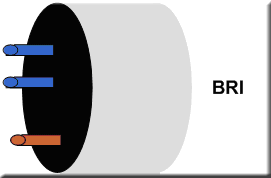
BRI (Basic Rate Interface)
Can also be known as BA (Basic Access), this operates a single 16Kbps D channel and two 64Kbps B channels. Although it isn't usually pointed out, the BRI total speed is 192Kbps, this is because you have an additional 48Kbps overhead for framing and synchronisation on the D channel. (64 * 2) + (16 + 48) = (128 + 64) = 192Kbps.
PRI (Primary Rate Interface)
Can also be known as PA (Primary Access), this can operate in two different modes depending on your geographic location. For European locations, PRI is made up of 30 x 64Kbps B channels and a single 64Kbps D channel which gives a total of 2.048Mbps which is also known as an E1 line (or DS1).
For American and Japanese locations, PRI is made up of 23 x 64Kbps B channels and a single 64Kbps D channel which give a total of 1.544Mbps which is also known as a T1 line (or DS1). Framing and Synchronisation is at 8Kbps for T1 or 64Kbps for E1. T1 PRI is commonly referred to as “23B+D” and for E1 PRI is commonly referred to as “30B+D”.
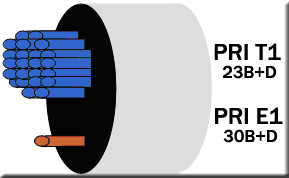
N.B. E1 PRI actually has 32 channels which are comprised of 30 x B Channels, 1 x D Channel and 1 Synchronisation Channel.
Digital Signal Levels (DSx)
Digital Signal X is used to describe standard digital transmission rates or levels based on DS0 which is defined as a transmission rate of 64Kbps. This is the rate for one telephone voice channel. This is based on the ANSI T1.107 guidelines and the ITU guideline does differ slightly. The following tables show you the DS level and the corresponding speed and T/E classification.
T Carrier
|
Digital Signal Level |
T Speed |
T Classification |
Channels |
|
DS0 |
64 Kbps |
N/A |
1 |
|
DS1 |
1.544 Mbps |
T1 |
24 |
|
DS2 |
6.312 Mbps |
T2 |
96 |
|
DS3 |
44.368 Mbps |
T3 |
672 |
E Carrier
|
Digital Signal Level |
E Speed |
E Classification |
Channels |
|
DS0 |
64 Kbps |
N/A |
1 |
|
DS1 |
2.048 Mbps |
E1 |
32 |
|
DS2 |
8.448 Mbps |
E2 |
128 |
|
DS3 |
34.368 Mbps |
E3 |
512 |
|
DS4 |
139.264 Mbps |
E4 |
2048 |
|
DS5 |
565.148 Mbps |
E5 |
8192 |
As you can see from the tables, you can see where the guidelines differ slightly. In fact, depending on what sources you read, these tables may differ slightly.
Point-to-Point Protocol (PPP)
ISDN will typically use the Point-to-Point (PPP) Tunnelling protocol as its basis of transmitting packets over the ISDN circuit. The IP Packets are encapsulated into the PPP packets before the traffic is sent.
PPP provides link specific control functions via Link Control Protocol (LCP) such as Link Configuration, Link Quality Testing & Address Negotiation. LCP provides more advanced features, such as Multilink, Header Compression, Callback, Scripting, Demand Dialing, Filtering, Tunnelling and Server Routing. There are also authentication mechanisms that can help to ensure that the ISDN connection that is established is from a trusted source. Authentication is optional which can be performed by the use of PAP, CHAP & EAP (although EAP is not used in ISDN implementations, EAP is however a valid authentication method of PPP).
PAP – Password Authentication Protocol is not strong since the password is sent in clear text. PAP occurs during the LCP phase of the PPP connection.
CHAP – Challenge Handshake Authentication Protocol, is much stronger then PAP and is much more widely used. It uses a Challenge/Response security mechanism which uses a one way Hash Function to ensure that the passwords are not sent over the link. The password is Hashed and sent over the link, the other side of the link then performs the same hashing function on the password that they have configured then check to ensure that the two hash values are the same. This can also provide protection against playback.
EAP – Extensible Authentication Protocol provides the ability to use multiple authentication protocols such as static passwords, CHAP, Token Cards, Biometrics, etc... As you can imagine, since CHAP is available on its own and ISDN cannot really work with Token Cards or Biometrics it isn't used in ISDN implementations.
The next article deals with ISDN Layers, Protocols & Components.
Enterprise-Class Cloud & Network Monitoring

Threat Traffic Analysis

Wi-Fi Key Generator
IT Infrastructure Monitoring

Follow Firewall.cx
Recommended Downloads
Cisco Password Crack
Decrypt Cisco Type-7 Passwords on the fly!
Automated Patching Solution

Firewall Analyzer