Late collisions, on the other hand, are not normal and are usually the result of out of spec. cabling or a malfunctioning adapter. A late collision is defined as any collision that occurs after 512 bits of the frame have been transmitted.
In this discussion we will refer to the same network described in the discussion of early collisions, but with one modification: In this network, the network administrator has violated the maximum cable length (500 meters for 10BASE5 thick ethernet, 185 meters for 10BASE2 thin ethernet) by either adding too many repeaters in between Stations A and B or by laying too much wire between them.
The following is an outline of a late collision event caused by out of spec. cabling:
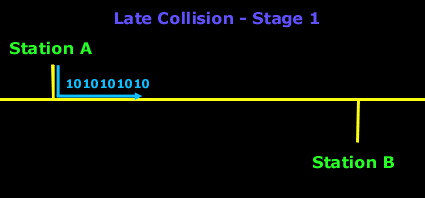
Station A, detecting that the wire has been idle for 9.6 microseconds, begins to transmit its data frame, beginning with the 64 bit preamble. Station A transmits 256 bits of its frame. If the cabling were in spec and Station B began to transmit, causing a collision, even if Stations A and B were on the farthest ends of the wire from each other the collision would be detected by station A before it could transmit its 512th bit. (Stage 1)
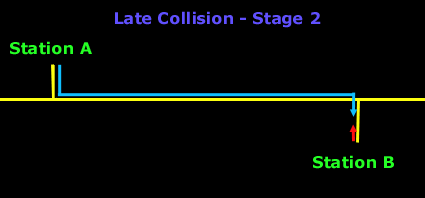
Station A continues to transmit bits, and meanwhile, down at the other end of the wire, just before the electrical signal reaches Station B, Station B detects idle wire for 9.6 microseconds and begins to transmit. (Stage 2)
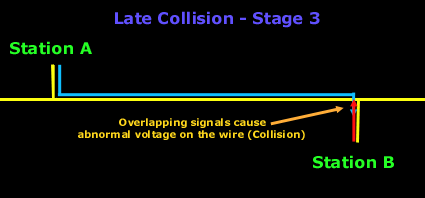
A minute amount of time later, a collision occurs. (Stage 3) Station B, being extremely close to the collision, detects it first and begins transmitting a 32 bit jam signal.
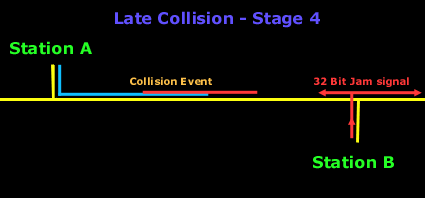
The collision begins to propagate down the wire towards Station A (Stage 4), followed by the 32 Bit Jam signal generated from Station B.
But because the cabling was out of spec. by the time it gets to Station A, Station A has already finished transmitting and is no longer listening for collisions! (Stage 5) Station A is completely unaware that a collision has occurred!
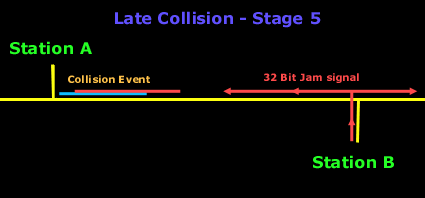
The reason that late collisions are a problem is that once the NIC misses the fact that a collision has occurred, recovery and retransmission are left to the upper layers and recovery time goes up drastically. While a NIC will typically recover and retransmit a frame in 2-3 milliseconds, it typically takes anywhere from 10 to 100 times that long for upper layers.
The other major cause of late collisions is a malfunctioning NIC. If a NIC malfunctions in such a manner that it is unable to detect that another station is talking, late (and early) collisions will occur.
Enterprise-Class Cloud & Network Monitoring

Threat Traffic Analysis

Wi-Fi Key Generator
IT Infrastructure Monitoring

Follow Firewall.cx
Recommended Downloads
Cisco Password Crack
Decrypt Cisco Type-7 Passwords on the fly!
Automated Patching Solution

Firewall Analyzer