There are a few different ways to approach subnetting and it can get confusing because of the complexity of some subnets and the flexibility they offer. For this reason I created this little paragraph to let you know how we are going to approach and learn subnetting. So.....
We are going to analyse the common subnet masks for each Class, giving detailed examples for most of them and allowing you to "see" how everything is calculated and understand the different effects a subnet mask can have as you change it. Once you have mastered this, you can then go on and create your custom subnet masks using any type of Class.
Default Subnet masks of each Class
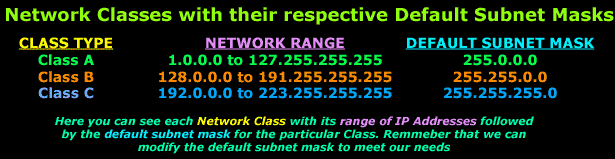
By now you should have some idea what the subnet mask does and how it's used to partition a network. What you need to keep in mind is that each Class has its DEFAULT subnet mask, which we can change to suit our needs. I have already mentioned this in the previous page, but we need to look into it in a bit more detail.
The picture below shows our 3 Network Classes with their respective default subnet mask:
The Effect of a Subnet Mask on an IP Address
In the IP Classes page we analysed and showed clearly how an IP Address consists of two sections:
1) The Network ID
2) The Host ID
This rule applies for all IP Addresses that use the default subnet mask and we call them Classful IP Addresses.
We can see this once again in the picture below, where the IP Address is analysed in Binary, because this is the way you should work when dealing with subnet masks:
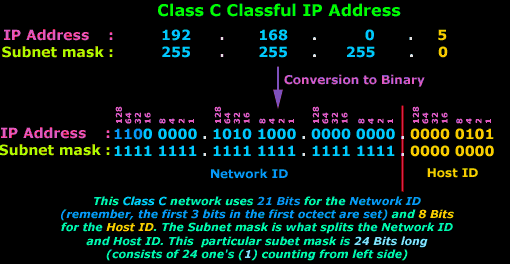
We are looking at an IP Address with its subnet mask for the first time. What we have done is take the decimal subnet mask and converted it to binary, along with the IP Address. It is essential to work in binary because it makes things clearer and we can avoid making silly mistakes. The ones (1) in the subnet mask "lock" or, if you like, define the Network ID portion. If we change any bit within the Network ID of the IP Address, then we immediately move to a different network. So in this example, we have a 24 bit subnet mask.
NOTE:
- All Class C Classful IP Addresses have a 24 bit subnet mask (255.255.255.0).
- All Class B Classful IP Addresses have a 16 bit subnet mask (255.255.0.0).
- All Class A Classful IP Addresses have an 8 bit subnet mask (255.0.0.0).
On the other hand, the use of an IP Address with a subnet mask other than the default results in the standard Host bits (the Bits used to indentify the HOST ID) being divided in to two parts: a Subnet ID and Host ID. These type of IP Addresses are called Classless IP Addresses.
In order to understand what a "Classless IP Address" is without getting confused, we are going to take the same IP Address as above, and make it a Classless IP Address by changing the default subnet mask:
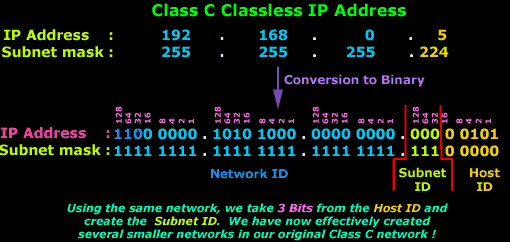
Looking at the picture above you will now notice that we have a Subnet ID, something that didn't exist before. As the picture explains, we have borrowed 3 bits from the Host ID and used them to create a Subnet ID. Effectively we partitioned our Class C network into smaller networks.
If you're wondering how many smaller networks, you'll find the answer on the next page. I prefer that you understanding everything here rather than blasting you with more Subnet ID's, bits and all the rest :)
Summary
In this page we saw the default subnet mask of each Class and also introduced the Classful and Classless IP Addresses, which are a result of using various subnet masks.
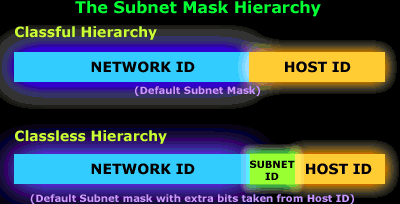
When we use IP Addresses with their default subnet masks, e.g 192.168.0.10 is a Class C IP Address so the default subnet mask would be 255.255.255.0, then these are "Classful IP Addresses".
On the other hand, Classless IP Addresses have their subnet mask modified in a way so that there is a "Subnet ID". This Subnet ID is created by borrowing Bits from the Host ID portion.
The picture below shows us both examples:
We hope you have understood the new concepts and material on this page. Next we are going to talk about subnet bits, learn how to calculate how many bits certain subnet masks are and see the different and most used subnet masks available.
Enterprise-Class Cloud & Network Monitoring
Threat Traffic Analysis

Wi-Fi Key Generator
IT Infrastructure Monitoring

Follow Firewall.cx
Recommended Downloads
Cisco Password Crack
Decrypt Cisco Type-7 Passwords on the fly!
Automated Patching Solution

Firewall Analyzer