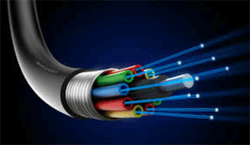
 In this article, we'll talk about Fiber optic cables and how it has changed the design and implementation of network infrastructures, providing high Gigabit speeds, increased security, flexibility and complete immunization from electromagnetic interference.
In the 1950s, more research and development into the transmission of visible images through optical fibers led to some success in the medical world where it was being used in remote illumination and viewing instruments. In 1966 Charles Kao and George Hockham proposed the transmission of information over glass fiber and realized that to make it a practical proposition, much lower losses in the cables were essential.
This was the driving force behind the developments to improve the optical losses in fiber manufacturing and today optical losses are significantly lower than the original target set by Charles Kao and George Hockham.
The Advantage of Using Fiber Optics
Because of the low loss, high bandwidth properties of fiber cables they can be used over greater distances than copper cables. In data networks this can be as much as 2 km without the use of repeaters. Their light weight and small size also make them ideal for applications where running copper cables would be impractical and, by using multiplexers, one fiber could replace hundreds of copper cables. This is pretty impressive for a tiny glass filament, but the real benefit in the data industry is its immunity to Electro Magnetic Interference (EMI), and the fact that glass is not an electrical conductor
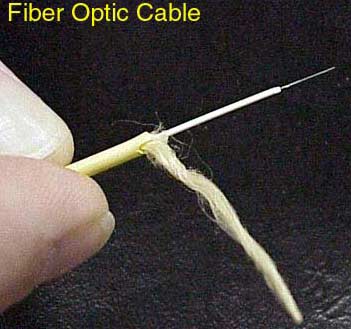
Figure 1. A Fiber Optic Cable
Because fiber is non-conductive it can be used where electrical isolation is needed, for instance, between buildings where copper cables would require cross bonding to eliminate differences in earth potentials. Fibers also pose no threat in dangerous environments such as chemical plants where a spark could trigger an explosion. Last but not least is the security aspect; it is very, very difficult to tap into a fiber cable to read data signals.
Fiber Construction
There are many different types of fiber cable, but for the purposes of this explanation we will deal with one of the most common types -- 62.5/125 micron loose tube. The numbers represent the diameters of the fiber core and cladding, these are measured in microns which are millionths of a meter.
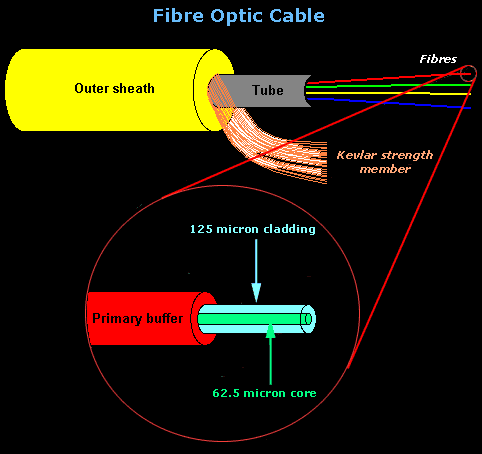
Figure 2. Construction of Fiber Optic Cable - Components
Loose tube fiber cable can be indoor or outdoor, or both. Outdoor cables usually have the tube filled with gel to act as a moisture barrier to the ingress of water. The number of cores in one cable can be anywhere from 4 to 144.
Over the years a variety of core sizes have been produced but these days there are three main sizes that are used in data communications, these are 50/125, 62.5/125 and 8.3/125. The 50/125 and 62.5/125 micron multi-mode cables are the most widely used in data networks, although recently the 62.5 has become the more popular choice. This is rather unfortunate because the 50/125 has been found to be the better option for Gigabit Ethernet applications.
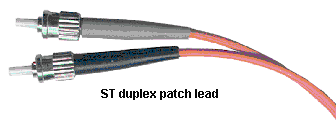
Figure 3. ST Duplex Patch Lead
The 8.3/125 micron is a single-mode fiber cable which until now hasn't been widely used in data networking due to the high cost of single mode hardware. Things are beginning to change because the length limits for Gigabit Ethernet over 62.5/125 fiber has been reduced to around 220m and now using 8.3/125 may be the only choice for some campus size networks.
What's the Difference Between Single-Mode and Multi-Mode?
With copper cables larger size means less resistance and therefore more current, but with fiber the opposite is true. To explain this we first need to understand how the light propagates within the fiber core.
Light Propagation
Light travels along a fiber cable by a process called 'Total Internal Reflection' (TIR); this is made possible by using two types of glass which have different refractive indexes. The inner core has a high refractive index and the outer cladding has a low index. This is the same principle as the reflection you see when you look into a pond. The water in the pond has a higher refractive index than the air and if you look at it from a shallow angle you will see a reflection of the surrounding area, however, if you look straight down at the water you can see the bottom of the pond

Figure 4. Light transmitted through a Fiber Optic cable
At some specific angle between these two views points the light stops reflecting off the surface of the water and passes through the air/water interface allowing you to see the bottom of the pond. In multi-mode fibers, as the name suggests, there are multiple modes of propagation for the rays of light. These range from low order modes, which take the most direct route straight down the middle, to high order modes, which take the longest route as they bounce from one side to the other all the way down the fiber.

Figure 5. Light bouncing while it travels inside a Fiber Optic cable
This has the effect of scattering the signal because the rays from one pulse of light arrive at the far end at different times; this is known as Intermodal Dispersion (sometimes referred to as Differential Mode Delay, DMD). To ease the problem, graded index fibers were developed. Unlike the examples above which have a definite barrier between core and cladding, these have a high refractive index at the centre which gradually reduces to a low refractive index at the circumference. This slows down the lower order modes allowing the rays to arrive at the far end closer together, thereby reducing intermodal dispersion and improving the shape of the signal.
So What About the Single-Mode Fiber?
Well, what's the best way to get rid of Intermodal Dispersion? Easy, only allow one mode of propagation. So a smaller core size means higher bandwidth and greater distances. Simple as that!
Free eBook - Endpoint Security

Enterprise-Class Cloud & Network Monitoring

Bandwidth Monitor

Wi-Fi Key Generator
Network and Server Monitoring

Follow Firewall.cx
Recommended Downloads
Cisco Password Crack
Decrypt Cisco Type-7 Passwords on the fly!
Automated Patching Solution

Firewall Analyzer