Novell's Proprietary Frame Format was developed based on a preliminary release of the 802.3 specification. After Novell released its proprietary format, the LLC Header was added, making Novell's format incompatible.
Below is a 3D diagram of the frame, let's have a look at it and try to analyse it:
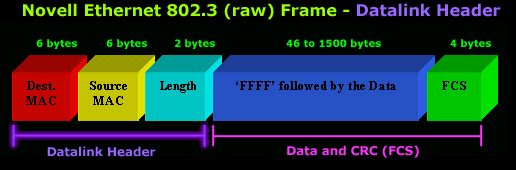
Offset 0-5: The Destination Address
Offset 6-11: The Source Address
Offset 12-13: Length
User Data And Frame Check Sequence (FCS)
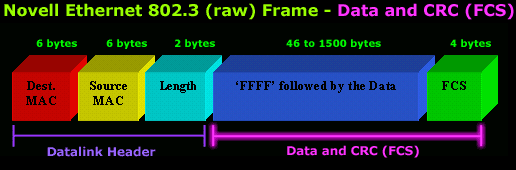
Data: 46-1500 Bytes
FCS: Last 4 Bytes
The last 4 bytes that the adapter reads in are the Frame Check Sequence or CRC. When the voltage on the wire returns to zero, the adapter checks the last 4 bytes it received against a checksum that it generates via a complex polynomial. If the calculated checksum does not match the checksum on the frame, the frame is discarded and never reaches the memory buffers in the station.
"A Novell client can only use one frame format for NetWare"
This is a true statement that needs some clarification to be fully understood.
It should be noted that Novell workstations are capable of using any of the four Ethernet frame types mentioned in the Ethernet Frame section, based on the LOAD and BIND settings in the NET.CFG file. A Novell client will use the list of frame formats in NET.CFG to attempt to locate a file server (or a Netware Directory Server for the VLM shell). The client starts at the top of the list of frame types in NET.CFG and broadcasts a 'Find Nearest Server' message. If no file server answers (or Directory Services server in a VLM client) then the client tries the next frame format. When a server finally does answer then the client will use the successful frame format from then on, until the client is rebooted.
As a result, you should remember that a Novell client will ultimately use only one of the four frame formats; it cannot actually use multiple formats for NetWare at the same time. The format it selects will be based on its initial attempt to locate a server. This behavior is restricted to the frame format used by NCP and SPX - if the client is also running a TCP/IP stack then the IP protocol can be configured to use any other frame format (typically Version II Ethernet).
This completes our anaylsis of the Novell proprietary frame format.




Decrypt Cisco Type-7 Passwords on the fly!