This article covers the installation of Cisco's CallManager Express on Cisco routers. Here you'll find the necessary installation commands, files to download, router's HTTP server configuration commands along side with the commands to activate the web CME interface and access it via a web browser.
As mentioned in our previous article CallManager Express GUI Software Installation & Configuration - Part 1, we'll be installing the file containing the basic CallManager GUI files. This is a common practice over the full version as free space on the system's flash is often a problem.
The 40MB .tar file (cme-basic-7.1.0.1.tar) should just about it on a system with a 128MB flash that already contains the Cisco IOS on it. While this file can be viewed using Winzip, it is intended to be extracted directly on to your CallManager platform using the CLI interface.
Using the necessary commands, the cme-full-7.1.0.1.tar file is extracted directly on to the device's flash memory. This means you must ensure you have enough free space on your router or UC500 flash, otherwise the extraction process will fail.
To extract the file, launch a TFTP server and ensure the file is accessible by the tftp server, then follow the below command:
The 'archive tar /xtract' command tells the router or UC500 to load the .tar file from our tftp server and extract it directly on to the router's flash. In total, our example had 132 files of which only 18 are the essential GUI files.
Opening the .tar file using Winzip and locating the files with the path 'gui\' will reveal the GUI related files:
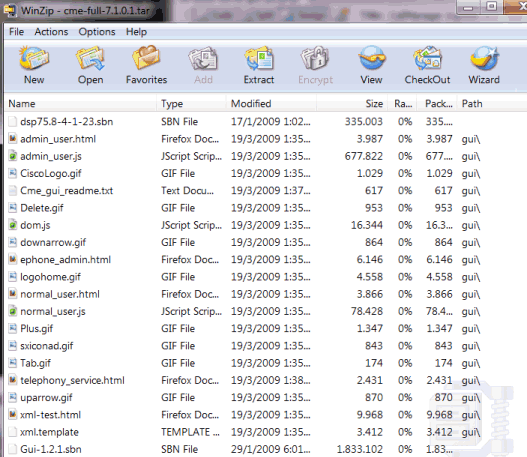
In the worst-case scenario, if there is limited space on the CallManager Express flash memory, simply extract the files with the 'gui\' path and upload them individually in the root directory of your flash memory.
Once uploaded on the router's flash, next step is to enable the router's http server, configure the authentication method, so that the router uses its local user accounts for authentication, and finally create a local user account with privilege 15 access and lower the file privilege level required for file operations. The file privilege command is necessary, otherwise we might experience telephony_service_server_get_action url:/ccme.html errors without any web page loading:
Alternatively, for increased security, it is possible to specify a user that will only be used for the CallManager Express GUI interface. This user will not have any other type of access to the CCME router as it is not considered a 'local account':
When entering the password or secret, type 0 reflects a non-encrypted password where as type 5 reflects an encrypted password.
We are now ready to access the Cisco CallManager Express GUI Interface using the following URL: http://10.0.0.1/ccme.html. This example assumes that the CallManager Express system is on IP address 10.0.0.1.
When typing the URL in our web browser, the system will request for a username and password. We enter the credentials accordingly and are presented with the CallManager Express homepage:
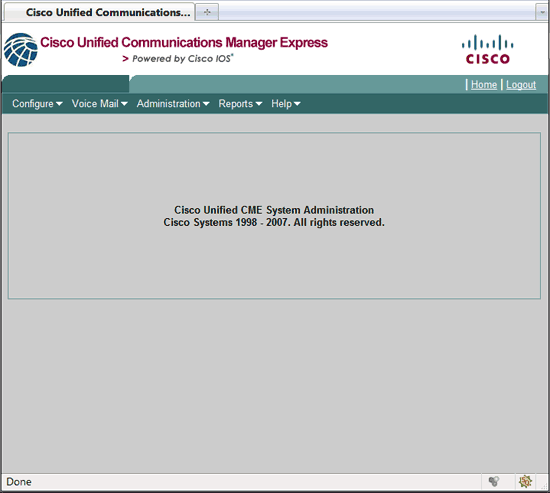
From here, we are able to configure basic system parameters, ip phone devices, create and assign extensions, receive basic call reports and much more.
The scope of this article will cover as much as the basic system parameter since the rest will be covered in future articles.
The begin setting up the basic system parameters, select 'Configure > System Parameters'. This will load the system parameter page where a number of options are available:
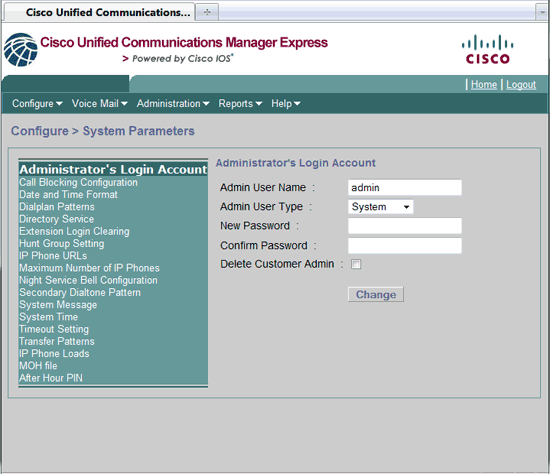
The most important parameters are outlined below:
As the parameters are set, the data entered are translated into CLI commands and placed under the 'Telephony-service' section of the router's or UC's configuration.
Below is the 'Telephony-service' configuration from a working CCME system. Notice that there are a lot more commands entered than available from the web interface, however it is fairly easy to locate the ones covered with the GUI interface. In-depth analysis and configuration of the telephony-service will be covered on another article:
Once complete, Cisco CallManager Express is ready to accept new IP phones and extensions.
As a last note, we should warn that Mozzila Firefox seems to have issues handing the javascript the GUI interface uses. This is especially evident when trying to assign extensions to physical IP phone buttons.
If you are using Mozzila Firefox and stumble into problems with the GUI interface, try switching to Internet Explorer - amazingly as it might sound, no problems have been encountered with it so far!
This article covered the Cisco CallManager Express GUI interface and how it relates to different IOS versions. We examined the CCME version contained in each IOS and where to obtain the necessary files.
We also saw the information contained in each CallManager Express specification page, how to select and download the appropriate CCME GUI files and what they contain.
Closing, we showed how to install the Cisco CallManager Express GUI files onto a Cisco router or UC500 series platform and provided the necessary commands required to get the GUI working. Basic system parameters were also covered, giving a view of the available options for Cisco CallManager Express.




Decrypt Cisco Type-7 Passwords on the fly!