The Transport layer is responsible for providing mechanisms for multiplexing upper-layer application, session establishment, data transfer and tear down of virtual circuits. It also hides details of any network-dependent information from the higher layers by providing transparent data transfer.
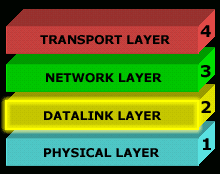
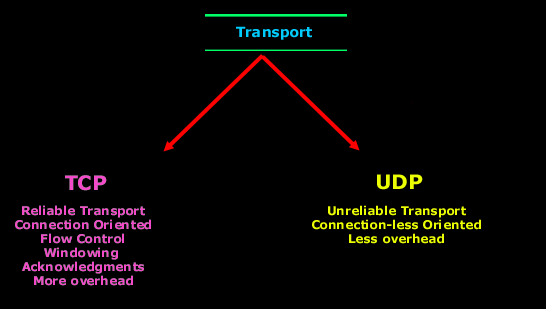
Services located in the Transport layer both segment and reassemble data from upper-layer applications and unite it onto the same data stream. Some of you might already be familiar with TCP and UDP and know that TCP is a reliable service and UDP is not. Application developers have their choice of the two protocols when working with TCP/IP protocols.
As mentioned above, the Transport layer provides different mechanisms for the transfer of data from one computer to another. Below is a brief diagram which tells you a bit about the protocols.
These protocols are also analysed in the Protocols section.
At this point, you can select to read about the TCP Protocol or UDP Protocol, or continue reading about the OSI Model.
Free eBook - Endpoint Security

Enterprise-Class Cloud & Network Monitoring

Bandwidth Monitor

Wi-Fi Key Generator
Network and Server Monitoring

Follow Firewall.cx
Recommended Downloads
Cisco Password Crack
Decrypt Cisco Type-7 Passwords on the fly!
Automated Patching Solution

Firewall Analyzer