The Network layer is responsible for routing through an internetwork and for networking addressing. This means that the Network layer is responsible for transporting traffic between devices that are not locally attached. Routers, or other layer-3 devices, are specified at the Network layer and provide routing services in an internetwork.
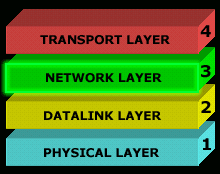
In the Open Systems Interconnection (OSI) communications model, the Network layer knows the address of the neighboring nodes in the network, packages output with the correct network address information, selects routes and quality of service and recognizes and forwards to the Transport layer incoming messages for local host domains.
Among existing protocol that generally map to the OSI network layer are the Internet Protocol (IP) part of TCP/IP and NetWare IPX/SPX. Both IP Version 4 and IP Version 6 (IPv6) map to the OSI network layer.
Some common protocols which work at the Network layer are: IP, DHCP, ICMP, IGRP, EIGRP, RIP, RIP2, MARS.
As mentioned above, the Internet Protocol works on this layer. This means that when you see an IP address, for example 192.168.0.1, this IP address maps to the Network layer in the OSI model, in other words only the Network layer deals with or cares about IP addresses in the OSI model. To keep things simple, IP is analysed under the "Protocols" section.
Free eBook - Endpoint Security

Enterprise-Class Cloud & Network Monitoring

Bandwidth Monitor

Wi-Fi Key Generator
Network and Server Monitoring

Follow Firewall.cx
Recommended Downloads
Cisco Password Crack
Decrypt Cisco Type-7 Passwords on the fly!
Automated Patching Solution

Firewall Analyzer